Lindapter Girder Clamps Are 9x Faster Than Site Welding
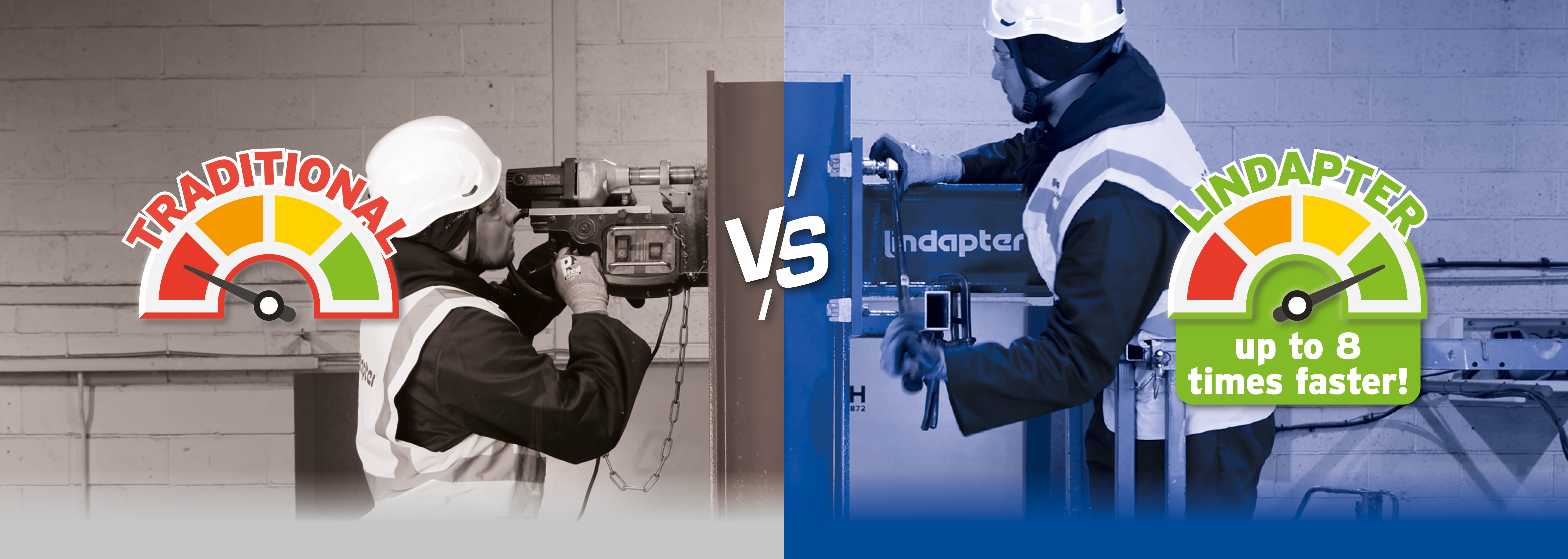
A few months ago, Lindapter put its girder clamps up against site drilling and bolting and published the results.
The response was immediate: what about welding?
Welding is the other default method the industry often falls back on, and for many projects it carries even more overhead than drilling.
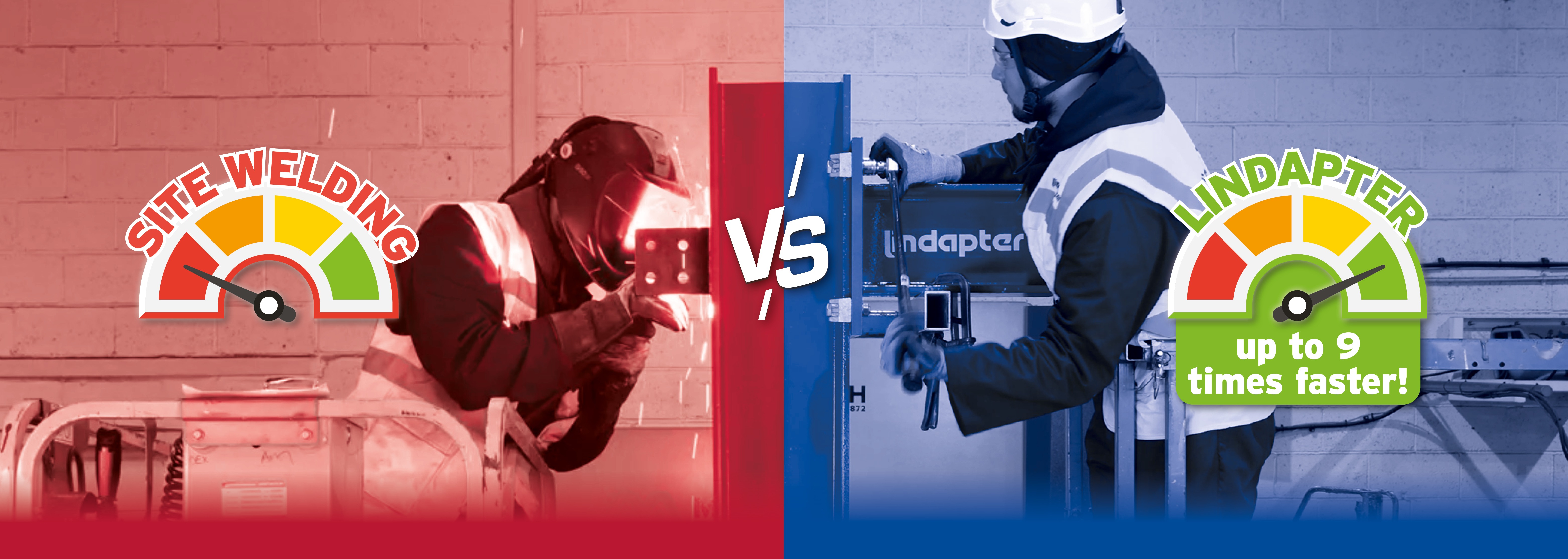
So Lindapter ran the same test again, this time against a site-welded connection.
The same rigour, the same transparency and the same insistence on measured figures rather than estimates.
The problem the industry has been living with
Site welding has a reputation for producing a strong, permanent connection and, in the right application, it does.
But strength on paper does not account for what it actually takes to get a welder onto site, qualified, equipped and working safely at height or within a live environment.
A welded connection is not a five-minute job.
It involves a sequence of preparation, execution, cooling, inspection and potential rework, with each stage adding time, cost and risk to a project.
Because welding is classed as hot work, it also introduces an additional layer of compliance for every connection, including permits, fire watches, ventilation and often restrictions on other trades working nearby.
Despite this, welding remains common practice across much of construction and fabrication.
This is not necessarily because it is the fastest or safest method available, but because it is familiar and because qualified welders and their equipment are what many teams have traditionally used.
Lindapter has argued for years that there is a faster, safer and equally strong alternative that removes hot work from the equation altogether.
So once again, the company decided to measure it.
The test: same connection, same conditions, real results
Lindapter repeated its controlled, like-for-like comparison with an independent fabricator.
The brief was simple: install the same four-bolt configuration connection twice.
One connection used site welding.
The other used Lindapter girder clamps.
The same steel, environment and starting point were used, with the datum line for the top of the new steelwork pre-marked on both sections to ensure alignment remained consistent between the two methods.
The only variable was the connection method.
Both installations were timed from start to finish on camera, making the process transparent and the results clear.
The result was:
Site welding: 21 minutes 34 seconds
Lindapter Girder Clamps: 2 minutes 24 seconds
That represents a time saving of 19 minutes 10 seconds on a single four-bolt connection.
Lindapter was nine times faster, reducing installation time by 88.87%.
These were measured and documented results from a controlled comparison using an independent fabricator under real working conditions, rather than estimates or projections.
Breaking down the welding process and every step it demands
Welding a structural connection is not a single action.
It is a chain of stages, with each one adding time and creating another point where something can go wrong.
Step 1: Equipment set-up
Before any welding begins, the team needs to move a welding machine, gas cylinders or wire feed, cabling and PPE to the connection point.
On projects where connections are at height or in awkward locations, repeatedly moving this equipment becomes a task in itself.
Most welding set-ups also require a suitable power source on site.
Step 2: Hot work permit and fire watch
Welding is classed as hot work in almost every environment where it takes place.
A permit is required before work can begin and, where suitable fire protection is not already in place, a dedicated fire watch operative, or sometimes several operatives, may need to remain present throughout the welding process and for a period afterwards.
That means another person, another cost and another point of coordination before a single weld has been completed.
Step 3: Surface preparation
The joint needs to be cleaned back to bare metal, with coatings, paint, rust or mill scale removed and the edges prepared to the correct profile.
Any contamination left on the surface can increase the risk of a defective weld, so this stage cannot be rushed.
Step 4: Tack welding and alignment
Before the full weld is completed, the sections are tack welded to hold them in position.
Getting the alignment right at this stage is important because once the full weld is made, the joint is fixed.
There is no simple adjustment available afterwards.
Step 5: Welding
The full weld pass, or passes, are then completed.
This generates significant heat, UV radiation, fumes and sparks and requires a qualified, certified welder working to the correct procedure for the joint and material.
Weather, wind and access conditions can all affect how long the process takes and how reliable the finished result is.
Step 6: Slag removal and cleaning
Once welding has been completed, slag and spatter need to be removed before the joint can be properly inspected.
If left in place, these materials can obscure the true weld profile and hide potential defects underneath.
Step 7: Cooling and inspection
The weld needs time to cool before it can be safely handled or inspected.
Visual inspection and, on many structural applications, non-destructive testing such as ultrasonic or dye penetrant testing may then be required to confirm that the weld meets specification.
If a defect is found, the affected section may need to be cut out and welded again.
Step 8: Coating reinstatement
Every weld burns back the protective coating beyond the weld line itself.
Galvanising or paint can be destroyed by the heat across a wider area, which then needs to be prepared and recoated to prevent corrosion beginning around the connection point.
The disadvantages of site welding
Choosing a welded connection rather than a clamped one can introduce a number of additional demands.
A qualified and certified welder is required, meaning not every operative on site can carry out the connection.
The availability of certified welders can also place additional pressure on project schedules.
Welding is classed as hot work, requiring permits, fire watches and, on many sites, restrictions on nearby trades while the work takes place.
Once a connection has been welded, there is no adjustment available.
If misalignment is found later, the joint may need to be cut out and remade.
Welding can also be affected by weather and access conditions.
Wind, rain and confined working areas can influence both weld quality and the time required to complete a connection safely.
The process generates fumes, UV exposure and burn risks, requiring appropriate ventilation, screening and PPE.
Heat from welding can also damage galvanising and painted coatings across a wider area, creating additional recoating work.
If an inspection identifies a defect, repairs are not necessarily quick.
The affected weld may need to be removed and the process started again.
Welding also introduces a heat-affected zone into the steel, permanently altering the material around the connection.
The Lindapter approach and why it removes these stages
Lindapter girder clamps grip the flange of an existing steel section without heat, without requiring a certified welder and without altering the steel.
There is no hot work, no cooling period, no inspection delay and no coating to reinstate.
The connection is also fully adjustable, allowing its position to be set, checked and altered before the clamp is finally tightened.
A welded joint does not provide the same opportunity for adjustment.
Because no heat is involved, there is no requirement for a hot work permit or fire watch.
The connection can be installed using standard hand tools by an installer already on site.
There is no heat-affected zone, meaning the material properties of the steel remain unchanged.
There is also no coating damage because the steel is neither heated nor cut.
Galvanising and paint remain intact around the connection.
The connection is complete and ready to carry load as soon as it has been tightened, with no cooling or curing period to include within the programme.
The installation also produces no welding fumes and is not affected in the same way by wind, rain or confined ventilation requirements.
Installation times remain more predictable from one connection to the next, whereas welding can vary depending on access, weather and welder skill.
The numbers at scale
Saving 19 minutes 10 seconds on a single connection is significant.
Across a project involving dozens or hundreds of connections, those savings can quickly accumulate.
The figures are based on the measured installation times recorded during Lindapter’s comparison.
In real working conditions, the difference may be even greater.
Welder fatigue, weather delays, permit renewals, fire watch rotas and equipment repositioning can all slow welding progress across a live project with multiple connections in ways that a controlled test does not capture.
These factors do not affect the Lindapter installer in the same way.
The tools are lightweight, the installation process is consistent and there is no hot work coordination required between connections.
The broader industry argument
The pressures facing structural steel projects have not eased.
Labour costs are increasing, certified welders are becoming harder to source and retain, schedules are tightening and health and safety scrutiny around hot work, fume exposure and working at height continues to grow.
Against this background, removing welding where it is structurally appropriate is not simply an argument about speed.
It is also about reducing risk.
Every hot work permit introduces additional responsibility.
Every welder working at height with live gas or an arc creates a safety exposure.
Every failed inspection can affect the programme.
Every area of protective coating damaged by heat can create a potential long-term corrosion issue.
Lindapter is not simply a faster connection method than welding.
It also offers a fundamentally lower-risk and more cost-effective alternative.
The question was about the numbers.
Lindapter measured them, and the results speak for themselves.
Anyone who has not already seen the Lindapter Girder Clamps vs Drilling and Bolting speed comparison video can also view the earlier test.
Visit the Lindapter International website for more information on Lindapter Girder Clamps Are 9x Faster Than Site Welding
ENQUIRY FORM